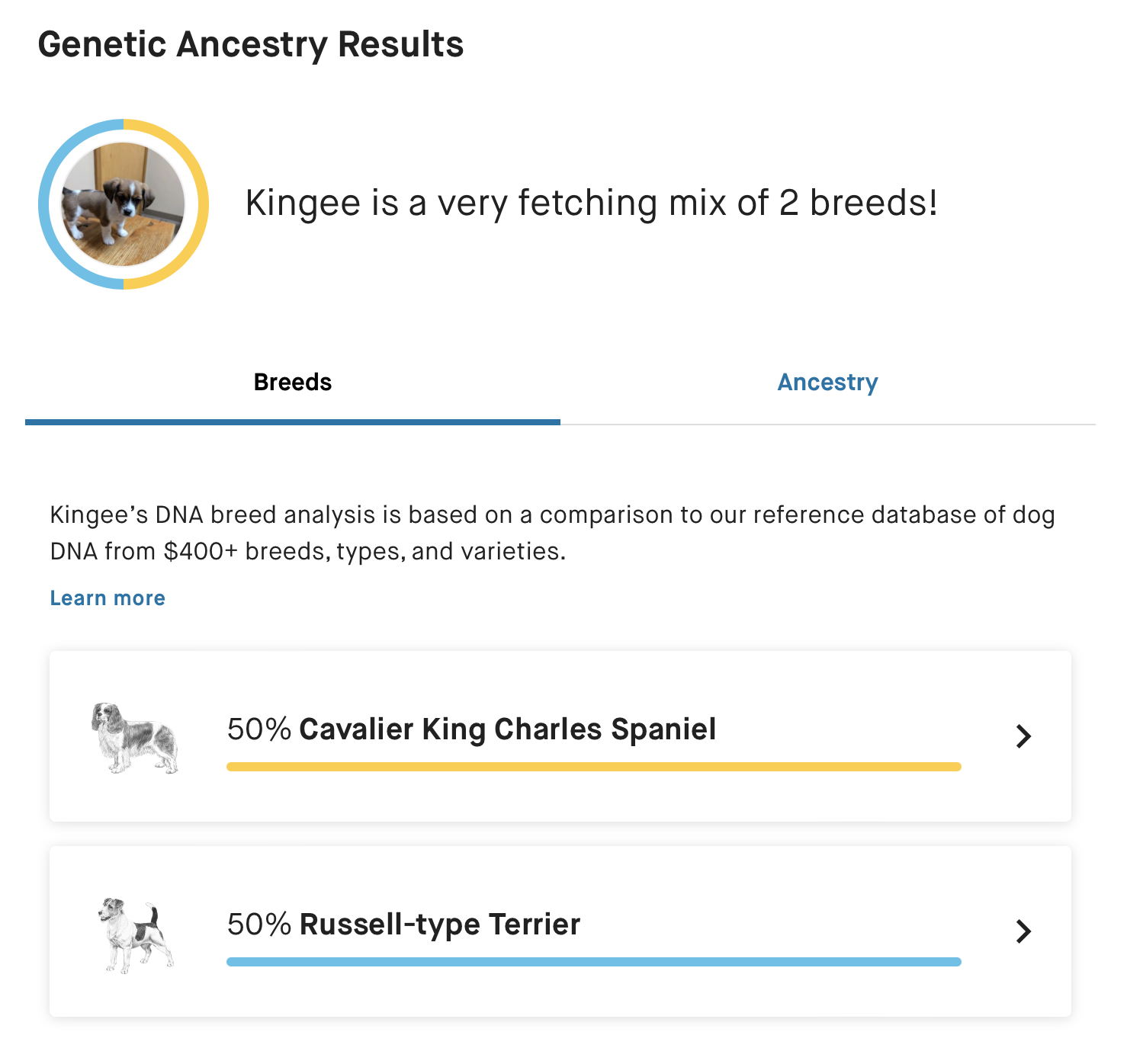
Screening for Cavaliers prior to Breeding
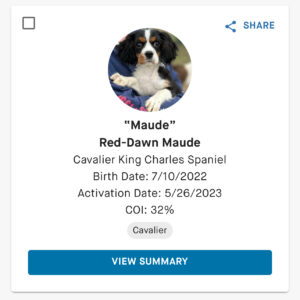
Maude
Maude is from American lines who are mostly not show dogs. These types of lines are called “pet bred”. Her inbreeding is 32%, the same as many Cavaliers.
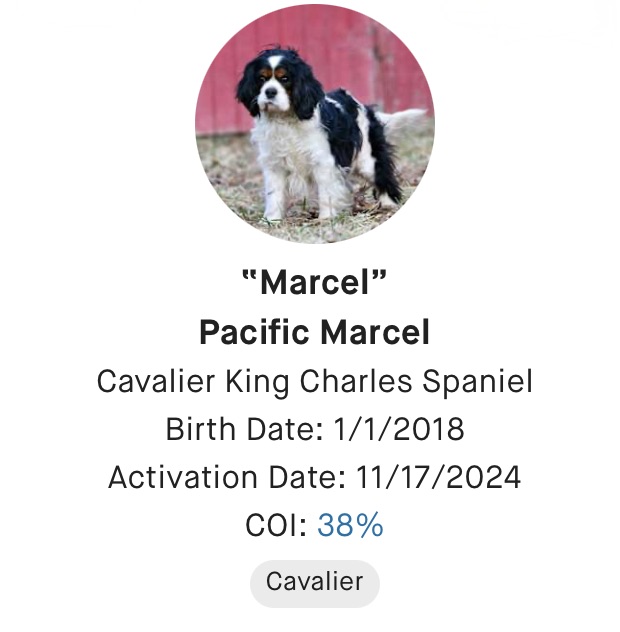
Marcel
On Embark’s DNA testing Marcel is 38% COI, meaning 38% of his genes are the same from each parent.
Pedigree link
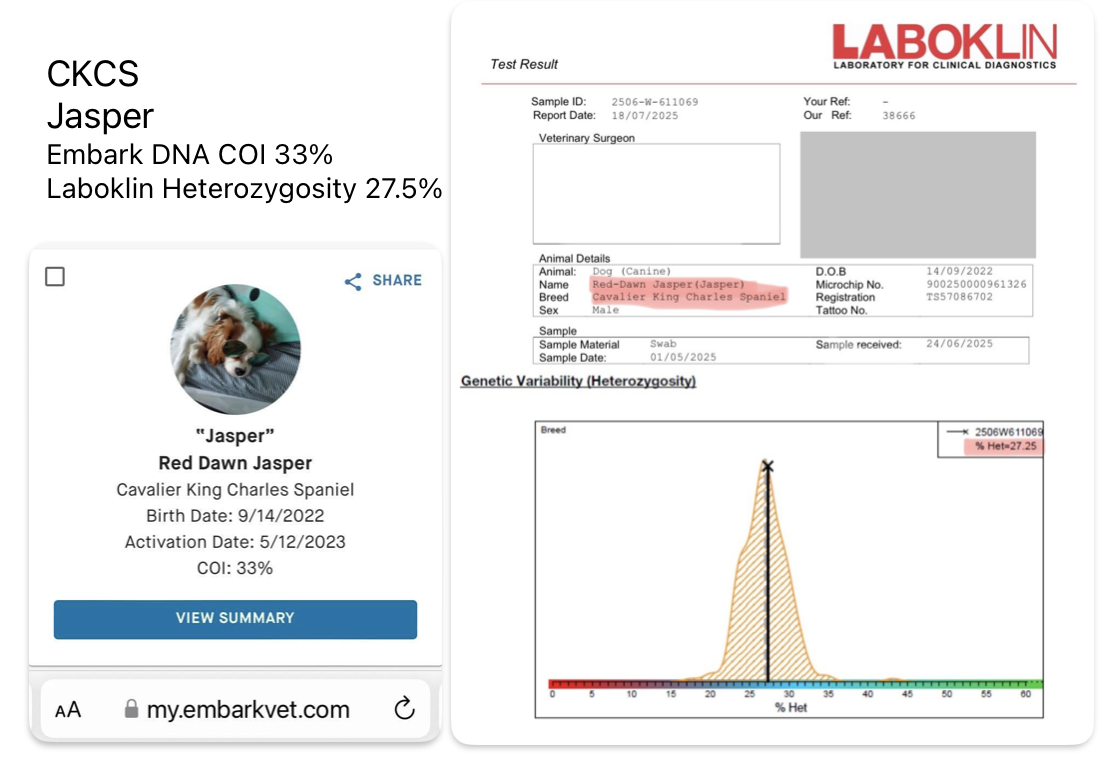
Jasper
Jasper has his DNA tested at two companies. Embark looks at runs of homozygosity, meaning how similar were the parents to each other. The result is called COI and the higher the score the more inbred the dog. Laboklin looks at Heterozygosity, meaning how similar is Jasper to the other Cavalier King Charles Spaniels tested by Laboklin. At the time of this test 300 CKCS were profiled and compared at Laboklin. In Heterozygosity the lower the score the more genetically diverse the dog is compared to his breed.
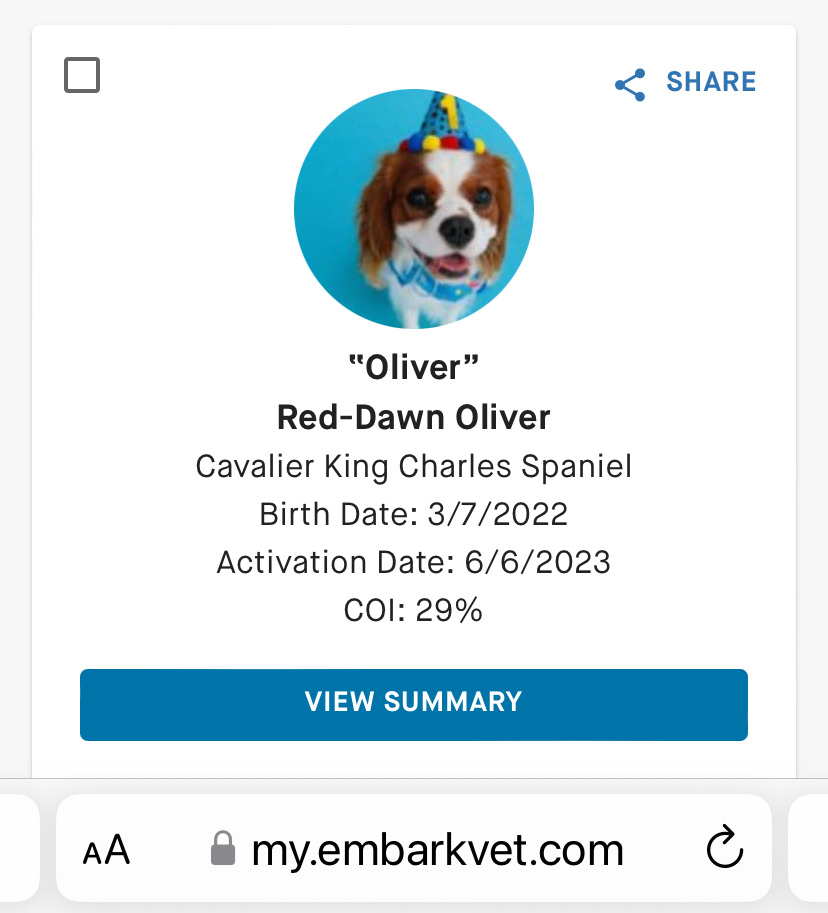
Oliver
Oliver comes from American lines of pet breeding, meaning not conformation show lines.
Pedigree link
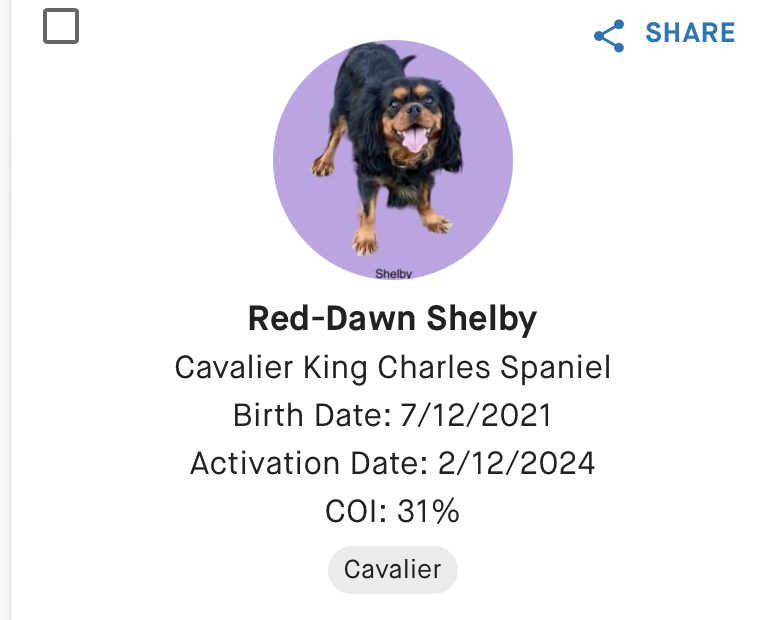
Shelby
Shelby is a blend of European and American lines.
Pedigree link
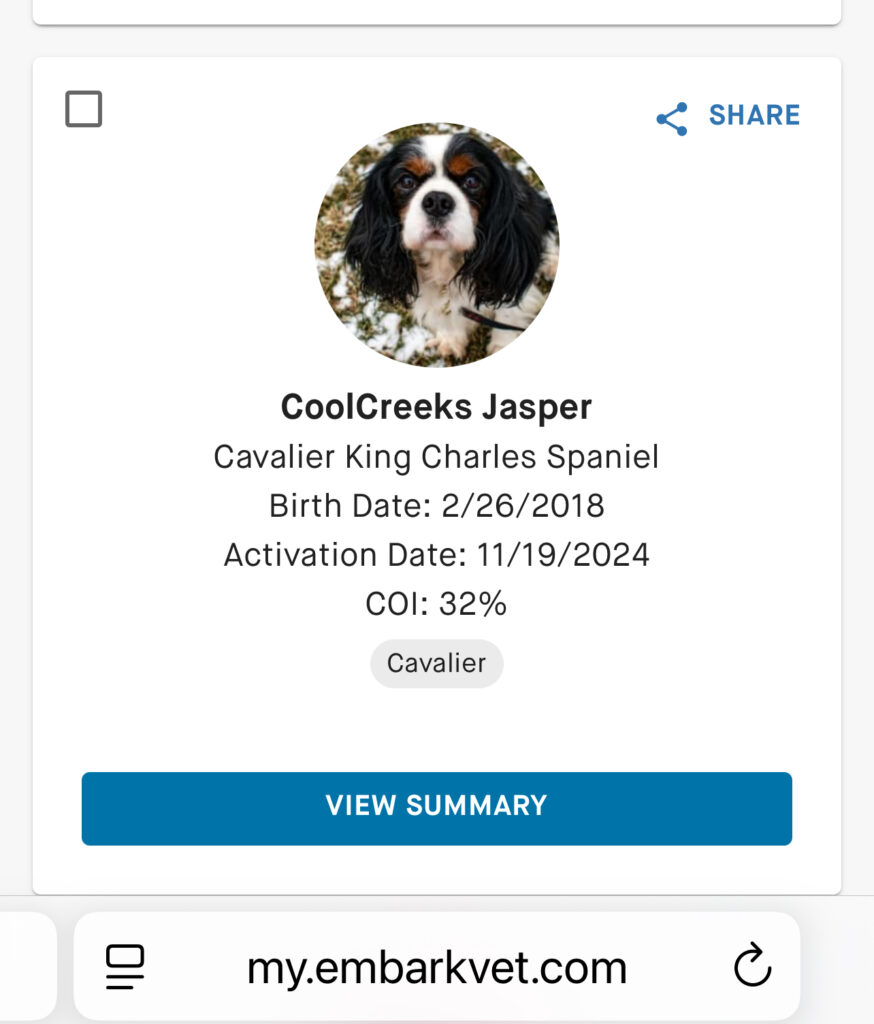
Coolcreek Jasper
Coolcreek Jasper is mostly American lines with some European and Australian / New Zealand lines.
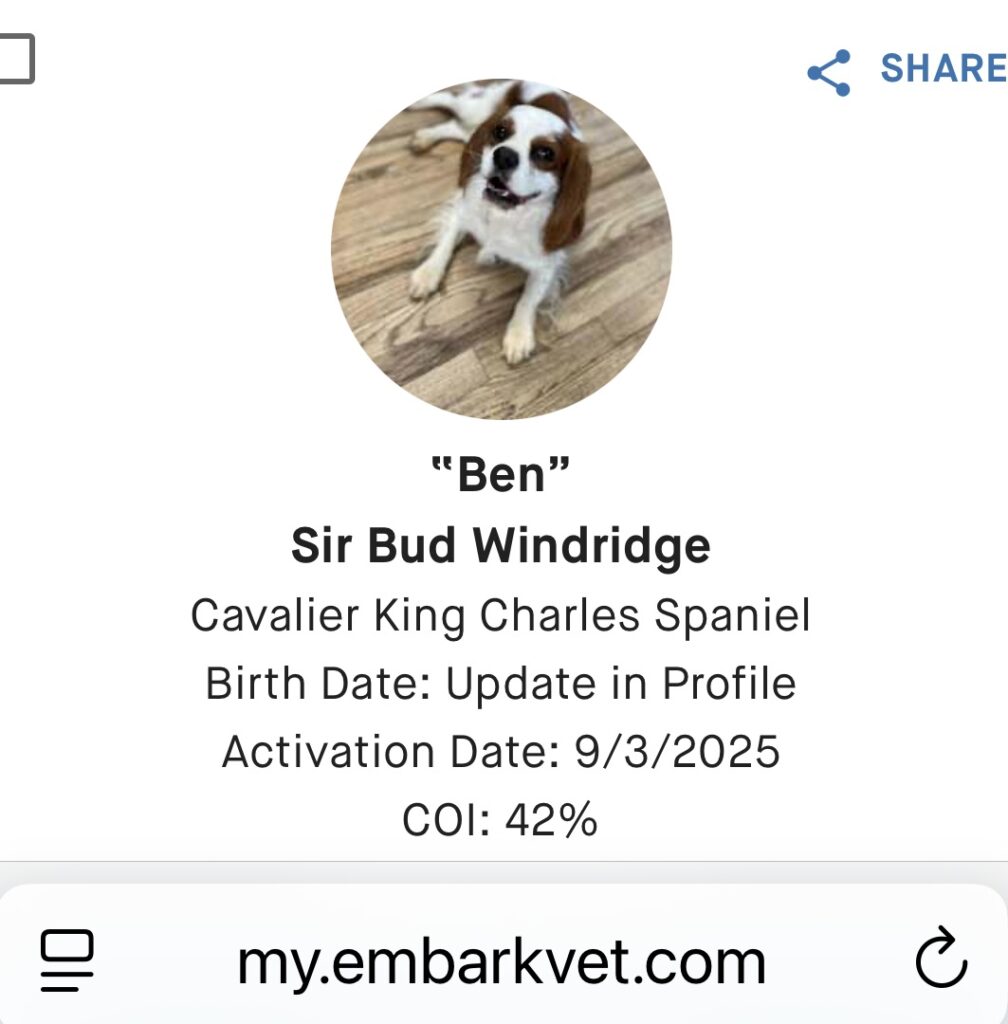
Ben
Ben is from American lines of CKCS. Embark DNA COI is 42%. Pedigree COI for 12 generations is 3.9%.
Eyes
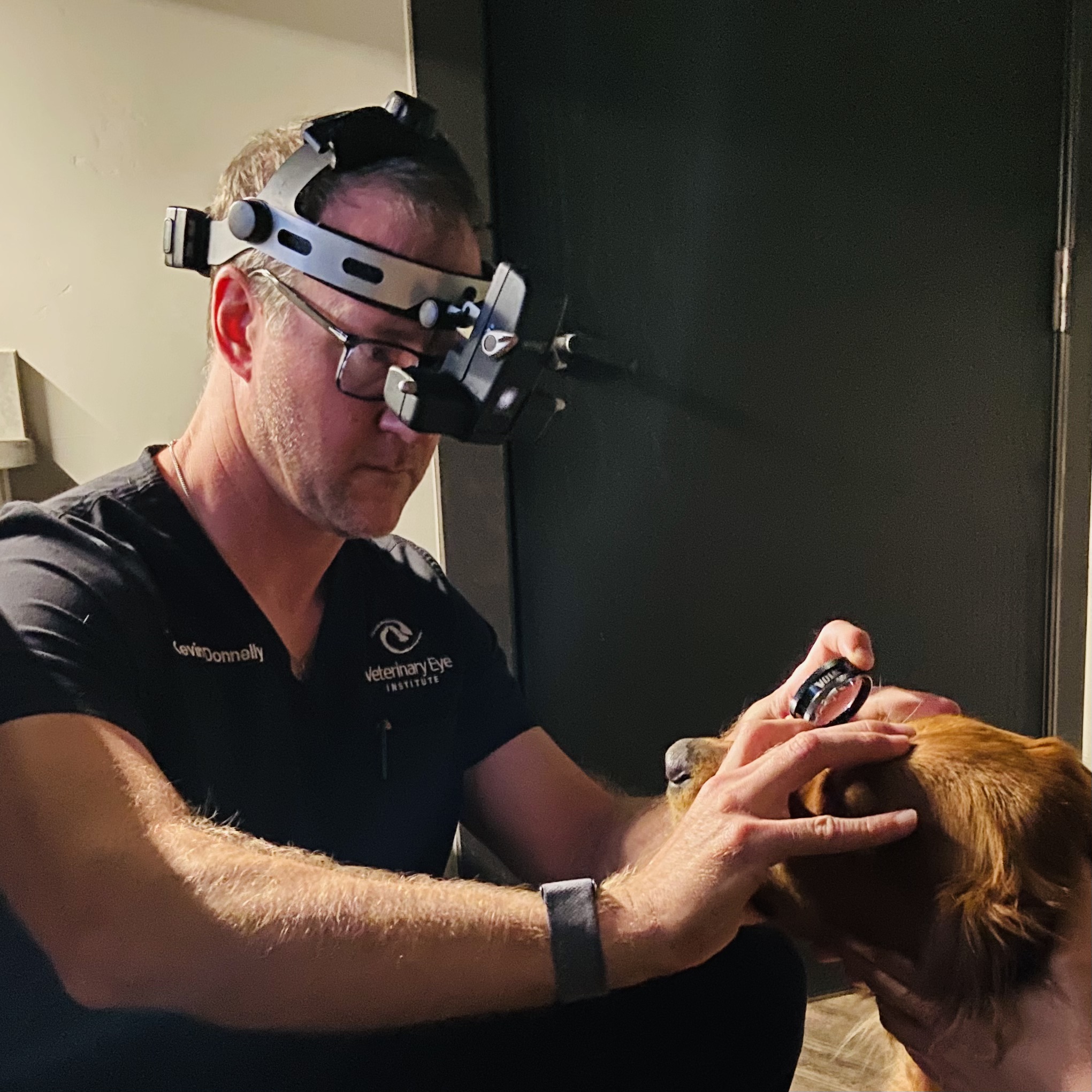
An opthalmologist should inspect the eyes of Cavaliers used for breeding. OFA records show 1000 dogs submitted each year in 2022, 2023, 2024. The most common catagories of conditions are:
8.2-9.8% DYSTROPHY-EPITHELIAL/ STROMAL
10% DISTICHIASIS
1.6-4.2% CATARACT-SIGNIFICANCE UNKNOWN
Learn about Eye Problems in Cavaliers
DNA
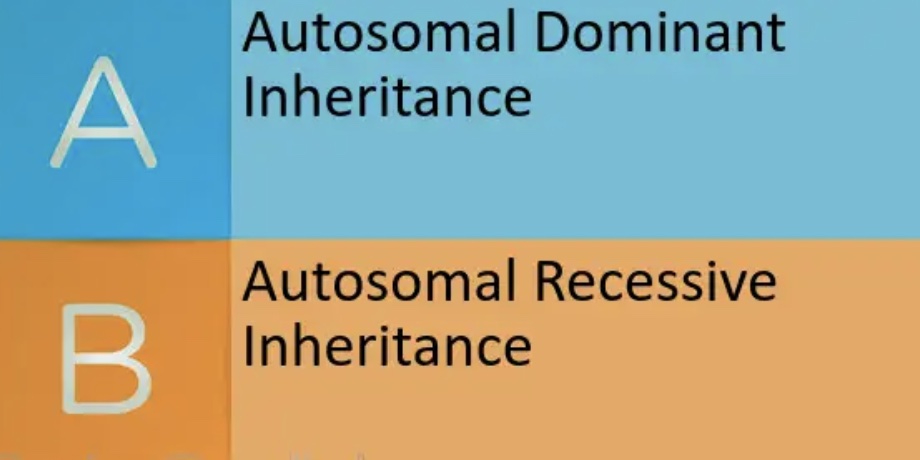
DNA disease testing gives data to breed away from common mendelian inherited conditions. DNA testing now gives us genetic inbreeding data, physical traits and analyst of breed types. DNA can aide in better choices in pairings of animals. The majority of DNA tests are Autosomal Recessive, meaning to be affected the individual must gain 1 copy from each parent, meaning the 2 copies are the same. A smaller percentage of disease testing finds genes who are Dominant, where only 1 copy from one parent causes the offspring to be ‘affected’. These are the 2 main categories of DNA tests for traits and diseases.
Learn about DNA Testing in Cavaliers
Inbreeding
Today we can DNA test a dog and know his inbreeding percentage. This technology has revolutionized understanding of dogs. Also, two dogs can be analyzed together to know the offspring’s potential inbreeding. This new science is easily utilized with Embark Genetics Genome-wide COI. Simply DNA test your dog at Embark to know your dog’s COI. Then later use their MatchMaker Tool and Pair Predictor tool to see what inbreeding the potential matches offer for offspring. Inbreeding calculation is called COI, Coefficient Of Inbreeding. All Cavaliers DNA tested in every study, are over 25% COI with the majority at 35-40% COI
Breed ID
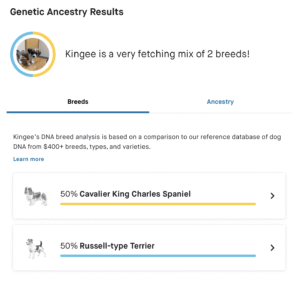
Breed type identification is an insightful tool. Multiple companies can look at a dog’s DNA and list the genetic breed makeup. This tool is especially useful for knowing percentages of breeds in a dog for a cross-breed program. For the purpose of our Cavalier Improvement Project, we will use this tool to attempt to keep the genetic blend of Cavalier approximately 50% of the offsprings genes. We also want to keep the other 50% a huge variety of breeds to aide in diversity.
Embark’s Breed ID, plus more
Wisdom Panel Breed ID, plus more
Embark's MatchMaker Tool
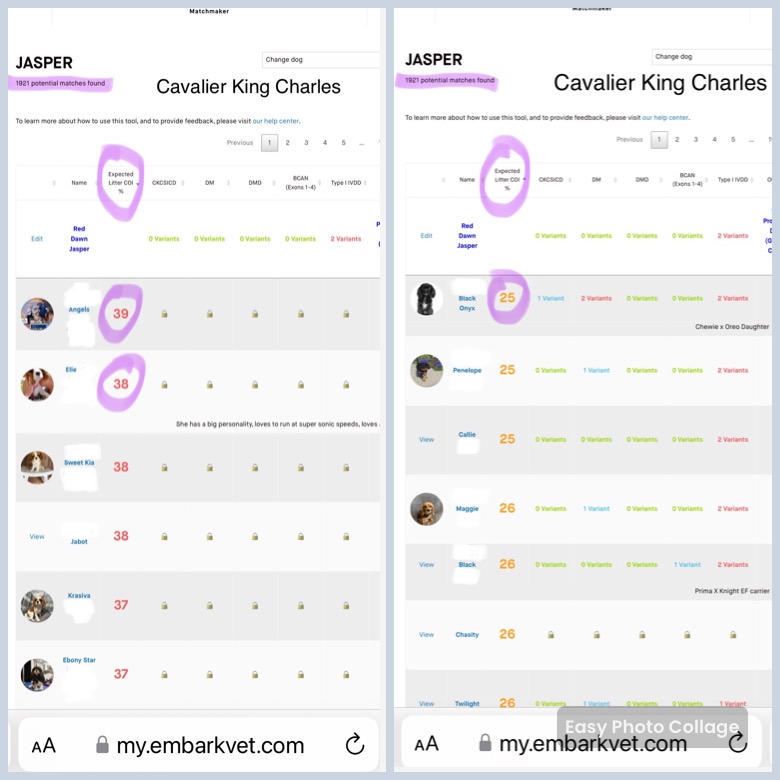
Embark’s Matchmaker Tool can suggest low or high COI pairing for a breeding dog. This is a valuable tool to know if a potential match is a good pairing choice. Gone are the days of looking at a written pedigree to decide if the potential parents are too closely related. DNA now tells us actual inbreeding of our dogs and their potential offspring. In this visual example Jasper is paired with multiple girls. The settings were for the lowest and highest inbreeding of options of thousands of Cavaliers profiled by Embark.
DNA
DNA disease testing gives data to breed away from common mendelian inherited conditions. DNA testing now gives us genetic inbreeding data, physical traits and analyst of breed types. DNA can aide in better choices in pairings of animals. The majority of DNA tests are Autosomal Recessive, meaning to be affected the individual must gain 1 copy from each parent, meaning the 2 copies are the same. A smaller percentage of disease testing finds genes who are Dominant, where only 1 copy from one parent causes the offspring to be ‘affected’. These are the 2 main categories of DNA tests for traits and diseases.
Learn about DNA Testing in Cavaliers
Inbreeding
Today we can DNA test a dog and know his inbreeding percentage. This technology has revolutionized understanding of dogs. Also, two dogs can be analyzed together to know the offspring’s potential inbreeding. This new science is easily utilized with Embark Genetics Genome-wide COI. Simply DNA test your dog at Embark to know your dog’s COI. Then later use their MatchMaker Tool and Pair Predictor tool to see what inbreeding the potential matches offer for offspring. Inbreeding calculation is called COI, Coefficient Of Inbreeding. All Cavaliers DNA tested in every study, are over 25% COI with the majority at 35-40% COI
Matchmaking
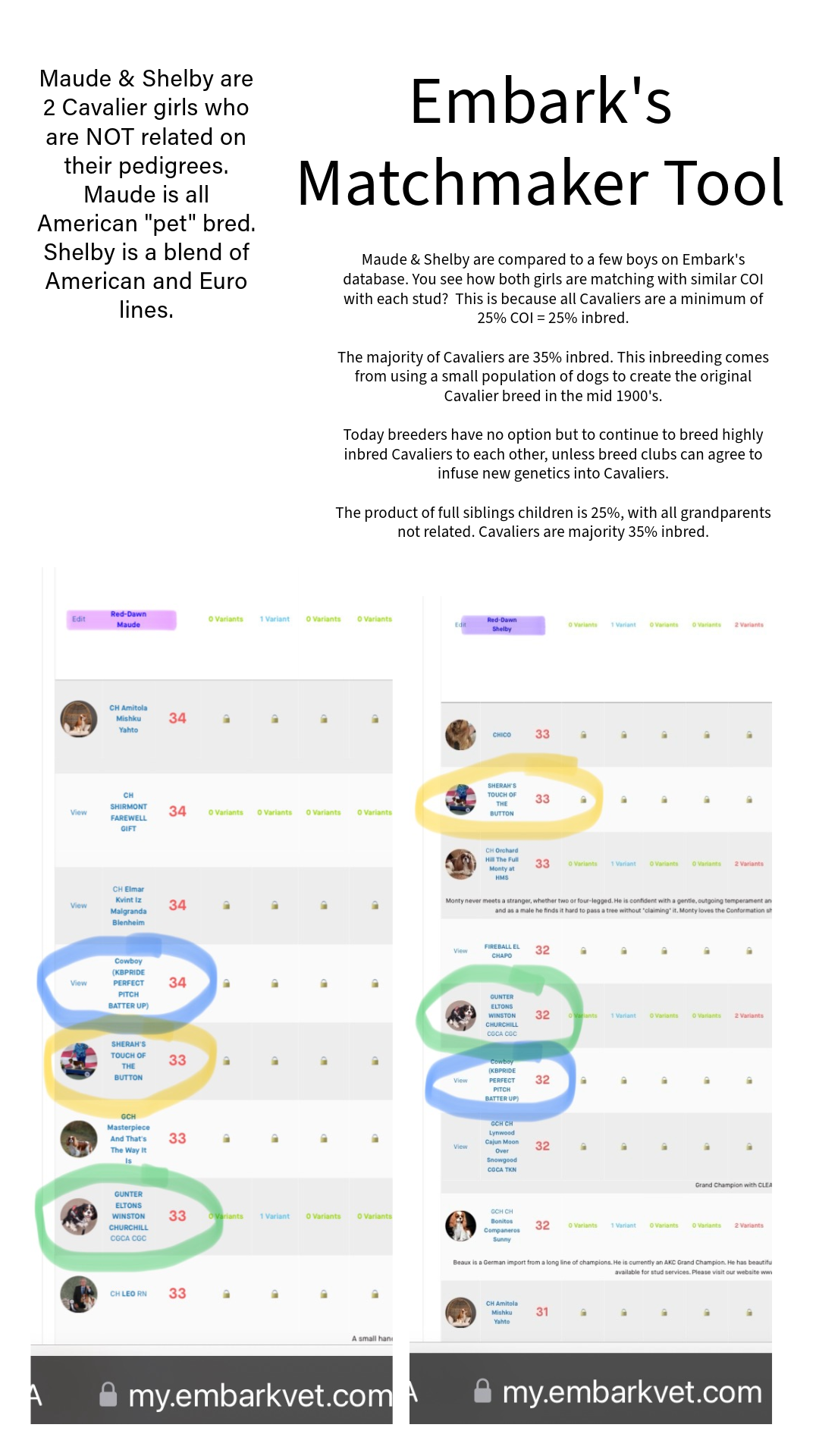
Three boys are matched with two girls. The COI is the same for each pairing despite the girls pedigrees being vastly different from each other. This is showing DNA tested inbreeding.
Embark's MatchMaker Tool
Embark’s Matchmaker Tool can suggest low or high COI pairing for a breeding dog. This is a valuable tool to know if a potential match is a good pairing choice. Gone are the days of looking at a written pedigree to decide if the potential parents are too closely related. DNA now tells us actual inbreeding of our dogs and their potential offspring.
Detrimental Health Conditions in Cavaliers
Contact Us